What Is the Rice Purity Test? A Simple 100-Question Guide

If a friend suddenly sends you a number like “82” or “47” with no explanation, there’s a decent chance they’re talking about the Rice Purity Test.
So, what is the Rice Purity Test? It’s a 100-question, self-graded quiz built around different life experiences. You answer whether you’ve had each experience, and your answers produce a score between 0 and 100. In the traditional scoring style, a higher score means you’ve checked off fewer of the listed experiences, while a lower score means you’ve checked off more.
That’s really the core of it.
The test is best treated as entertainment, a conversation starter, or a simple way to reflect on your experiences. It isn’t a personality test, medical assessment, psychological evaluation, or judgment of your character.
I’ve spent about three years working with and learning about the Rice Purity Test format, and one thing is worth saying right away: the number is much less serious than the name “purity” makes it sound.
What Is the Rice Purity Test, Exactly?
The simplest Rice Purity Test definition is this: it’s a checklist-style quiz containing 100 questions about experiences you may or may not have had.
Most versions use straightforward yes-or-no responses. You go through the list, mark the experiences that apply to you, and receive a final number.
The questions generally touch on areas such as:
- Dating and relationships
- Affection and intimacy
- Parties and social situations
- Alcohol or other substances
- School or college experiences
- Encounters with rules or authority
- Other common life experiences
Some questions are very ordinary. Others are more personal. You never need to answer anything you’re uncomfortable answering, especially if you’re taking the test with other people.
The Rice Purity Test meaning is often misunderstood because of the word “purity.” The quiz isn’t actually capable of deciding whether someone is pure, innocent, responsible, mature, or anything else. It simply converts answers from one fixed list of experiences into a number.
That distinction matters.
Where Did the Rice Purity Test Come From?
The Rice Purity Test is associated with Rice University in Houston, Texas.
Historical records show that The Rice Thresher, Rice University’s student newspaper, published an informal 10-question survey involving female undergraduates in 1924. Later versions changed substantially, including much longer questionnaires. The familiar 100-question format developed through later student quiz traditions rather than appearing fully formed in that original survey.
That history also explains the “Rice” in the name. It refers to Rice University, not the food.
Today, you’ll find many versions of the 100 Question Purity Quiz online. The wording, design, and presentation can vary from one site to another, so two versions may not always be identical.
For most people taking it today, though, the appeal is much simpler than its history. It’s a quick quiz that can spark funny conversations with roommates, friends, or a partner.
Read More: The Rice Purity Test College Tradition Explained
How Does the 100-Question Rice Purity Test Work?
If you’re wondering what is the Rice Purity Test process like, it’s surprisingly easy.
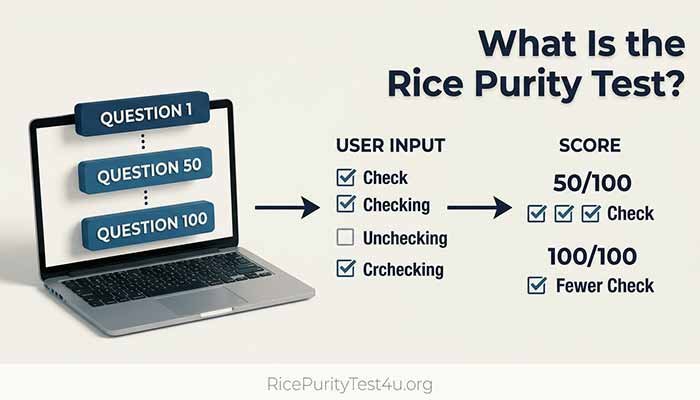
You read each of the 100 questions and indicate whether the experience applies to you. Once you finish, your responses are converted into a score.
In the traditional scoring method, you effectively start at 100 and lose a point for each listed experience you mark. So if you mark 20 experiences, your score would be 80.
No question needs a long written response. There are no essays, explanations, or “correct” answers.
What Does a Higher Score Mean?
A higher score generally means you’ve experienced fewer of the things included in that particular questionnaire.
For example, someone with a score closer to 100 has marked relatively few items.
That doesn’t automatically mean the person is more responsible, better behaved, happier, healthier, or more mature. It only tells you how many items from that quiz they didn’t mark.
What Does a Lower Score Mean?
A lower score means more of the listed experiences applied to the person.
Again, that isn’t a grade.
Someone with a lower score hasn’t “failed” the Rice Purity Test. They simply checked more items from its 100-question list.
This is one reason I recommend resisting the urge to treat scores like school grades. A 90 isn’t an A, and a 40 isn’t an F.
What Does the Rice Purity Test Measure?
People often ask, what does the Rice Purity Test measure?
The most accurate answer is: it measures how many experiences from its own questionnaire you report having had.
That’s narrower than saying it measures innocence or purity.
A person’s life can’t realistically be summarized by 100 yes-or-no questions. The test doesn’t know the circumstances behind an experience, when something happened, how you felt about it, or what you learned from it.
Two people could even have the same score while checking completely different questions.
That’s why a Rice Purity score works better as a conversation piece than as a serious label.
Does this sound familiar? Someone shares a score in a group chat, everyone starts comparing numbers, and five minutes later the group is far more interested in guessing which questions everyone checked than in the scores themselves.
That social side is a big part of the fun.
Rice Purity Test Explained: Why People Still Take It

The format is simple, which makes it easy to use in several different situations.
College Students
College students may take the quiz with roommates or friends as an icebreaker. Because the questions cover a broad mix of experiences, the quiz can lead to stories, jokes, and conversations that wouldn’t normally come up during everyday small talk.
There’s one useful rule here: nobody owes the group an explanation.
You can share your score without sharing individual answers.
Couples
Couples sometimes use the quiz as a casual conversation starter.
Instead of focusing on who has the higher or lower score, you can use interesting questions as jumping-off points for talking about your past experiences, boundaries, or funny memories.
Keep it voluntary. A quiz should never become an interrogation.
Friends
With friends, the Rice Purity Test often works best when everyone agrees beforehand on how much they want to share.
Maybe everyone reveals only a final score. Maybe you discuss a few funny questions. Maybe everyone takes the quiz privately and says nothing afterward.
All three approaches are completely reasonable.
Is the Rice Purity Test Really About “Purity”?
Not in any meaningful scientific or moral sense.
The word is part of the quiz’s traditional name and scoring concept, but you shouldn’t read too much into it.
When people ask me for the Rice Purity Test meaning, I prefer a practical explanation: the score represents your responses to a particular set of life-experience questions. Nothing more needs to be attached to it.
A high score shouldn’t make someone feel superior.
A low score shouldn’t make someone feel embarrassed.
And two people with dramatically different scores can still have plenty in common.
That mindset makes the quiz much more enjoyable.
How to Take the Rice Purity Test Without Making It Awkward
The quiz contains personal topics, so a little common sense goes a long way.
First, answer honestly only if you want the score to reflect your actual responses. There’s no prize for getting a specific number, so trying to manufacture a “good” score defeats the point.
Second, give yourself and other people privacy.
If you’re taking the quiz in a dorm, apartment, or group setting, you don’t need to read every answer aloud. Let people complete personal questions quietly.
Third, don’t pressure anyone to reveal which questions they marked.
A person might happily share a score while preferring to keep the details private.
Finally, avoid using someone’s result as evidence about their character. The test doesn’t provide enough context for that kind of judgment.
In my opinion, the quiz is far more fun when nobody treats it like a competition.
Can You Compare Rice Purity Test Scores?
You can compare scores for fun, especially when you’re using the same version of the quiz.
Just remember what the comparison actually tells you.
Suppose one friend scores 85 and another scores 55. You can say that the second person marked more items on that particular questionnaire. You cannot reliably conclude that one person has had a better, worse, safer, wilder, healthier, or more meaningful life.
The questions themselves also vary across some online versions, which can make comparisons less useful if everyone took a different test.
If you’re doing the quiz as a group, using the same 100 questions keeps things simple.
Is the Rice Purity Test Private?
Privacy depends on the website or method you use to take it.
The quiz format itself doesn’t require you to publicly share your answers, name, score, or personal details. You can take it on your own and keep the result completely to yourself.
However, websites can have different privacy practices. Before entering sensitive information on any online quiz, it’s reasonable to check what the site says about data collection and storage.
You should also think about social privacy.
Taking a quiz privately on your phone is very different from answering every question while five friends watch your screen.
Choose the setup that feels comfortable for you.
What Is the Rice Purity Test Good For?
For me, the best way to understand what is the Rice Purity Test is to focus on what it can realistically offer.
It can be a fun quiz.
It can start conversations.
It can give you a simple moment of self-reflection.
It can help friends or couples learn unexpected things about each other when everyone genuinely wants to participate.
What it can’t do is define you.
Your score doesn’t summarize your personality, values, relationships, maturity, or future. It’s just the result of answering a 100-question checklist.
Take the number lightly, respect other people’s privacy, and the experience becomes much more enjoyable.
FAQs:
Final Thoughts
So, what is the Rice Purity Test? It’s a 100-question life-experience quiz that turns your yes-or-no responses into a score from 0 to 100.
Higher numbers generally reflect fewer checked experiences, while lower numbers reflect more checked experiences. Neither result is automatically good or bad.
If you’re taking it with college friends, your partner, or just out of curiosity, treat it as entertainment and self-reflection rather than a judgment.
Answer what you’re comfortable answering, keep personal responses private when you want to, and don’t overthink the final number.
That’s really all the Rice Purity Test needs to be: a simple quiz and maybe the beginning of an interesting conversation.
CTA: Curious where your answers will take you? Keep it light, answer only what you’re comfortable with, and try the quiz for yourself.