How Does The Rice Purity Test Work?

If you’ve seen friends sharing Rice Purity Test scores and wondered what happens behind that number, you’re probably asking: How does the Rice Purity Test work?
The basic idea is surprisingly simple. You go through a list of 100 questions about different life experiences, mark the ones that apply to you, and receive a score between 0 and 100. The more experiences you check, the lower your final score becomes.
That’s really the core of it.
Still, understanding the scoring system can make the quiz much less confusing—especially when you’re comparing results with friends or taking it for the first time. I’m Mateo, and after three years of working with Rice Purity Test content, I’ve found that the easiest way to understand the quiz is to separate the questions, answers, and score calculation.
Here’s how it all fits together.
How Does The Rice Purity Test Work Step by Step?
The Rice Purity Test uses a checklist-style format rather than traditional multiple-choice questions.
You read each item and decide whether you have had the experience described. If you have, you select it. If you haven’t, you leave it unchecked.
Once you finish all 100 questions, your selections are used to calculate your final score.
In simple terms:
- The test begins with a score of 100.
- Each checked experience reduces that score.
- More checked items generally mean a lower score.
- Fewer checked items generally mean a higher score.
The result isn’t a grade, diagnosis, or judgment about you. It simply summarizes how many of the listed experiences apply to you.
That distinction matters. A score of 80 isn’t an “A,” and a score of 40 isn’t a failure. The quiz is better treated as a fun conversation starter or a way to reflect on your experiences.
How To Take Rice Purity Test Questions
Taking the test doesn’t require much preparation.
You simply work through the questions from beginning to end and answer based on your own experiences.
Read Each Question Carefully
Some questions may sound similar at first, so reading the complete wording helps.
Try not to rush just because you’re taking the quiz with a group of friends. Your result is based entirely on which questions you select, so answering accurately gives you a result that better reflects your own responses.
Check Only Experiences That Apply to You
If you have experienced what a question describes, check it.
If you haven’t, leave it unchecked.
You don’t need to select something simply because your friends did. You also don’t need to explain any of your answers to someone else.
That privacy is part of what makes this kind of quiz easy to enjoy. You can compare scores without discussing every individual answer.
Complete All 100 Questions
The standard format uses Rice Purity Test 100 questions, covering a broad mix of social, romantic, personal, and rule-breaking experiences.
You don’t earn points by answering individual questions correctly because there are no correct or incorrect answers.
Instead, your selections are counted at the end.
Does this sound different from the quizzes you took in school? It should. This test isn’t trying to measure knowledge.
How Is Rice Purity Score Calculated?
This is probably the most common point of confusion.
Fortunately, how is Rice Purity score calculated has a very straightforward answer.
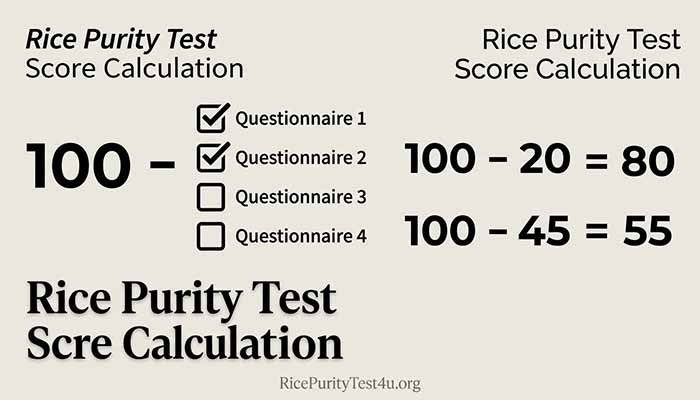
The standard scoring formula can be understood as:
100 − number of checked questions = Rice Purity score
For example, imagine someone completes all 100 questions and checks 18 items.
Their calculation would be:
100 − 18 = 82
Their Rice Purity score would therefore be 82.
If another person checked 45 questions:
100 − 45 = 55
That person’s score would be 55.
No complicated percentages or weighted questions are needed in this basic scoring model. Each checked experience counts toward reducing the final score.
A Quick Scoring Example
Here are a few examples to make the pattern clearer:
| Checked Questions | Final Score |
|---|---|
| 5 | 95 |
| 10 | 90 |
| 25 | 75 |
| 40 | 60 |
| 60 | 40 |
| 80 | 20 |
Once you understand this relationship, the scoring system becomes pretty easy to follow.
Understanding The Rice Purity Test Scoring System
The Rice Purity Test scoring system works in the opposite direction from many familiar tests.
On a school exam, answering more questions correctly normally increases your score.
Here, checking more experiences decreases your score.
That means a person who has checked only a few items could receive a score close to 100, while someone who has checked many items could receive a much lower result.
Neither result automatically says anything good or bad about that person.
That’s one reason I think comparing Rice Purity scores works best when everyone remembers that the test is entertainment rather than a competition.
People have different backgrounds, boundaries, relationships, personalities, and life experiences. A single number can’t capture all of that.
Read More: Rice Purity Test Score Meaning: What Your Result Really Means
What Do High and Low Scores Actually Represent?
Because of the scoring method, higher and lower numbers describe how many listed experiences were selected.
A higher score means fewer questions were checked.
A lower score means more questions were checked.
That’s the useful factual distinction.
It’s tempting to attach personality labels to different scores, especially when friends start comparing results. But the test itself doesn’t provide enough information to make serious judgments about someone’s personality, maturity, values, or lifestyle.
Two people can even receive the same score while checking completely different questions.
For example, two friends might both score 72. That simply tells you that they each checked 28 questions. It doesn’t tell you that their individual answers matched.
That’s a useful detail to remember when you see someone post only their final score.
How Rice Purity Test Result Calculation Works Behind the Number
The Rice Purity Test result calculation essentially turns your 100 yes-or-no selections into one number.
Think of your unchecked questions as the points remaining in your score.
If you check:
- 0 questions, your score is 100.
- 20 questions, your score is 80.
- 50 questions, your score is 50.
- 75 questions, your score is 25.
- 100 questions, your score is 0.
That also explains why the score can feel backward the first time you take the test.
You aren’t building points as you answer. You’re starting from 100 and reducing the number according to the experiences you’ve selected.
Once you know that, interpreting the basic mechanics becomes much easier.
Can Two People Get the Same Score With Different Answers?

Absolutely.
This is one of the most interesting parts of the test when friends or couples compare results.
Suppose you and a friend both check 30 questions.
You would both receive a score of 70.
However, you might have selected entirely different combinations of questions.
The scoring system counts the number of selected experiences rather than creating a detailed profile based on exactly which experiences you chose.
So the final number tells you how many items were checked, not which ones.
That makes the score useful for lighthearted comparison, but it also shows why you shouldn’t read too much into a single number.
Should You Answer Every Question Honestly?
If you want the score to reflect your actual experiences, answering honestly makes sense.
That doesn’t mean you need to share those answers afterward.
You can take the quiz privately, see your result, and decide whether you want to share only the final score—or nothing at all.
When friends take the test together, there can sometimes be a temptation to change an answer because someone is watching.
I’d avoid treating it that seriously.
The quiz is more enjoyable when you’re answering for yourself rather than trying to produce a particular score.
Is a Higher Rice Purity Score Better?
Not objectively.
A higher score only tells you that fewer listed experiences were selected. A lower score tells you that more were selected.
The Rice Purity Test isn’t designed to decide who is a better person.
There’s also no universal score everyone should aim for.
That’s why comparing scores works best as casual fun. You might laugh about surprising differences between friends or use the questions to start a conversation, but the number doesn’t need to become a label.
Your score is simply the outcome of your answers to one particular set of questions.
Why Do People Compare Rice Purity Scores?
Part of the appeal is curiosity.
You may know your friends pretty well and still be surprised when everyone’s scores appear on screen.
Couples might compare scores to spark conversations about their past experiences. College friends might take the test together for fun. Others may simply be curious about their own result.
The score gives people an easy number to compare without requiring everyone to reveal each individual response.
Still, there’s no rule saying you have to share it.
Your answers and result can stay completely personal if that’s what you prefer.
What Your Rice Purity Test Result Cannot Tell You
Knowing how does the Rice Purity Test work also means understanding its limits.
Your result does not provide a professional assessment of your health, personality, relationships, character, or future behavior.
It also doesn’t explain the context behind your experiences.
A checklist can count selected answers, but it can’t understand why something happened, how you felt about it, or what you’ve learned since then.
That’s why the best way to approach the result is casually.
Use it for entertainment. Compare it with friends if everyone is comfortable. Reflect on the questions if you find them interesting.
Then move on with your day.
FAQs:
Final Thoughts
So, how does the Rice Purity Test work?
You answer 100 experience-based questions by checking the ones that apply to you. Your checked answers are counted and subtracted from 100 to produce your final score.
More checked questions lead to a lower score, while fewer checked questions lead to a higher one.
The process is simple, which is probably part of what makes the quiz so easy to take with friends, couples, or classmates.
Just remember that the result is a number from an entertainment quiz—not a judgment about who you are. Have fun with it, keep your answers as private as you want, and don’t feel pressured to chase any particular score.
Curious to see how the scoring works with your own answers? Keep it private, answer at your own pace, and have fun with it.