Rice Purity Test Score Calculator: How Your Score Is Calculated

You finish the Rice Purity Test, see a number out of 100, and immediately wonder: “Okay, but where did that score come from?”
The good news is that the math is surprisingly simple.
A Rice Purity Test Score Calculator for the traditional 100-question test starts you at 100 points and subtracts one point for every item you check. So, if you check 27 items, your final score is 73. There are no complicated percentages or category weights in the standard scoring method.
That simple formula also makes it easy to calculate or double-check your score yourself. Let’s break down exactly how it works, what the number does and does not tell you, and how to avoid common scoring mistakes.
How Does a Rice Purity Test Score Calculator Work?
The traditional Rice Purity Test contains 100 items. You go through the list and check the experiences that apply to you.
The scoring starts at 100.
Each checked item reduces that number by one point.
So the basic Rice Purity Score Formula is:
Rice Purity Score = 100 − Number of Checked Items
That’s it.
For example, imagine you work through the quiz and check 18 statements.
100 − 18 = 82
Your Rice Purity score would be 82 out of 100.
If you checked 46 items:
100 − 46 = 54
Your score would be 54 out of 100.
Because the traditional quiz contains exactly 100 items, your number of checked items and your final score always add up to 100.
Read More: Rice Purity Test For Friends: How to Take It Together
How to Calculate Rice Purity Score Step by Step
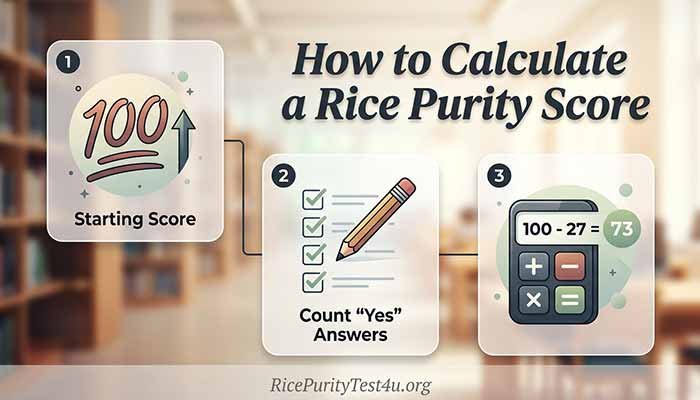
If you’re trying to Calculate Rice Purity Score without an automatic calculator, you only need to count your checked answers.
Step 1: Go Through All 100 Questions
Read each item and decide whether it applies to your experience.
There’s no reason to rush. A question you misread can change your score by one point, so taking a little extra time makes your result easier to understand.
And remember, this is supposed to be a fun quiz. You don’t need to answer based on what you think your friends would say or what would produce a certain score.
Step 2: Count the Items You Checked
Once you finish, count the total number of checked items.
Let’s say you checked 31.
That number represents how many statements from the 100-item list applied to you.
Step 3: Subtract That Number From 100
Now use the Rice Purity score formula:
100 − 31 = 69
Your final result is 69.
A Rice Purity Test Score Calculator simply handles this subtraction automatically so you don’t have to count and calculate everything manually.
Why Is the Score Out of 100?
The classic format works nicely as a Score Out Of 100 Quiz because there are 100 questions and every checked item changes the score by one point.
If you check zero items, the calculation is:
100 − 0 = 100
If you check 10 items:
100 − 10 = 90
If you check 50:
100 − 50 = 50
At the other end of the scale, checking all 100 items would produce:
100 − 100 = 0
This makes the result easy to read without converting anything into a separate percentage.
One detail matters here: a Rice Purity score should not be treated like a school grade. An 85 is not the same thing as earning 85% on an exam, and a 45 does not mean you “failed.”
It is simply the result of subtracting your checked items from 100.
Does Every Question Have the Same Value?
Yes, in the traditional scoring system.
Every checked item counts as one point against the starting score of 100. One question does not remove five points while another removes one. The standard calculation does not assign extra weight based on the subject of the question.
I think this is one of the most useful things to understand about the quiz because people can easily assume that certain questions must affect the score more than others.
They don’t.
If two people each check 25 items, they both receive a score of 75 even if they checked completely different statements.
That also tells you something important about the result: the final number shows how many listed experiences apply, not which experiences they were.
Read More: Rice Purity Test Score Chart: Understanding Scores From 0 to 100
How to Find Rice Purity Score From Your Answers
Wondering How To Find Rice Purity Score when you already know how many questions you checked?
You can reverse the math instantly.
Here are a few examples:
- 12 checked items = score of 88
- 24 checked items = score of 76
- 37 checked items = score of 63
- 52 checked items = score of 48
- 70 checked items = score of 30
The pattern stays the same every time: subtract the number checked from 100.
You can also work backward.
If someone has a score of 81:
100 − 81 = 19
That means 19 items were counted as checked.
A Rice Purity Test Results Calculator can automate the same process, but knowing the formula makes it easy to verify the result yourself.
What Does a Higher or Lower Score Actually Mean?
In purely mathematical terms, a higher score means fewer items on that particular checklist were checked. A lower score means more were checked.
That’s all the score can tell you directly.
For example:
A score of 90 corresponds to 10 checked items.
A score of 60 corresponds to 40 checked items.
A score of 25 corresponds to 75 checked items.
It’s tempting to turn those numbers into labels about someone’s personality, maturity, relationships, or lifestyle. The calculation itself doesn’t support that.
Two people can get exactly the same score from completely different combinations of answers.
Does this sound familiar? You and a friend compare scores, discover you’re only two points apart, and start assuming you must have answered everything almost the same way. Not necessarily.
The total gives you a number. The individual answers provide the context.
For that reason, I prefer thinking of the Rice Purity Test as entertainment and a conversation starter rather than a rating system.
Can Two People Have the Same Score With Different Answers?

Absolutely.
Suppose Alex checks 30 items and Jordan also checks 30 items.
Both scores are:
100 − 30 = 70
But Alex and Jordan do not need to have checked the same 30 questions.
The Rice Purity Test Score Calculator only needs the total number of checked items to produce the final score. It doesn’t create a unique score based on specific combinations.
This is why comparing scores can be fun with friends or a partner, but the number alone doesn’t reveal someone’s complete set of answers.
And nobody owes anyone those answers. If you’re taking the quiz with other people, sharing the final score or discussing individual questions should always be optional.
Common Rice Purity Score Calculation Mistakes
The formula is easy, but a few things can still cause confusion.
Counting Unchecked Questions Instead of Checked Questions
The usual method starts at 100 and subtracts the number of items you checked.
If you checked 22 items, your score is 78. You don’t need a separate percentage calculation.
Treating the Score Like a Percentage Grade
A result of 72 means 28 items were checked. It doesn’t mean you got 72% of the questions “correct.”
There are no correct or incorrect answers in that sense.
Giving Certain Questions Extra Points
The traditional formula gives each checked item the same one-point effect. Don’t manually assign larger deductions to questions that seem more significant.
Comparing Scores From Different Quiz Versions
Not every quiz online necessarily uses the exact same question list or scoring method.
If you’re comparing results with friends, make sure you’re using the same version. Otherwise, a score of 70 on one quiz may not represent exactly the same checklist as a 70 on another.
Can You Calculate Your Score Without a Calculator?
Yes.
For the traditional 100-question version, all you need is:
100 − checked answers = final score
You can do it mentally, write it down, or use a basic calculator.
An automatic Rice Purity Test Score Calculator is mainly convenient because it can calculate the total as you complete the quiz. The underlying arithmetic remains simple.
If you ever think your result looks wrong, count the items you selected and subtract that number from 100. It’s an easy way to double-check the result.
Your Rice Purity Score Is a Quiz Result, Not a Judgment
The most useful way to read a Rice Purity score is literally.
If your score is 64, then 36 of the 100 items were counted as checked.
That’s the mathematical information the score provides.
It does not determine whether you’re a good person, a bad person, experienced, inexperienced, mature, immature, or anything else that requires understanding your actual life and circumstances.
The Rice Purity Test works best when you keep it light. Take it privately, compare scores with friends or a partner if everyone wants to, laugh about surprising differences, or simply keep your result to yourself.
Once you know the formula, there’s no mystery behind the number: start at 100, subtract one for each checked item, and you have your score.
FAQs:
CTA: Curious what number you’ll get? Keep it fun, answer at your own pace, and see how the simple scoring formula works in practice.