What Is A Good Rice Purity Score?

If you just finished the Rice Purity Test, there’s a good chance one question popped into your head right away: What is a good Rice Purity score?
The simple answer is that there isn’t one universally “good” score.
A higher score generally means you checked off fewer experiences on the quiz, while a lower score means you checked off more. Neither result automatically says anything good or bad about you. The Rice Purity Test works best as entertainment, a conversation starter, and a little self-reflection—not as a judgment of your personality, character, or choices.
I’m Mateo, and I’ve spent the past three years working with and learning about the Rice Purity Test. One thing I always recommend is keeping the score in perspective. It’s much more fun when you treat the number as a snapshot of experiences rather than a grade you need to pass.
Let’s break down what different scores can mean and how to think about your result without overthinking it.
What Is A Good Rice Purity Score, Really?
A Rice Purity score typically falls somewhere between 0 and 100.
The basic scoring idea is simple: higher numbers generally reflect fewer of the experiences covered by the quiz, while lower numbers reflect more of them.
That means someone scoring 90 and someone scoring 50 have answered the questions differently. It does not mean one person did better.
So, what is a good Rice Purity score?
For entertainment purposes, any honestly earned score can be considered a perfectly fine result. There is no official passing score, ideal target, or number everyone should try to reach.
Think of it less like an exam score and more like the result of a personality-style quiz. The interesting part is seeing where you land and talking about it if you feel comfortable doing so.
Your result may also change over time because your life experiences can change. That is another reason not to attach too much meaning to one number.
Read More: 60 Fun Questions For A Sleepover Everyone Will Love
Understanding High vs Low Rice Purity Scores
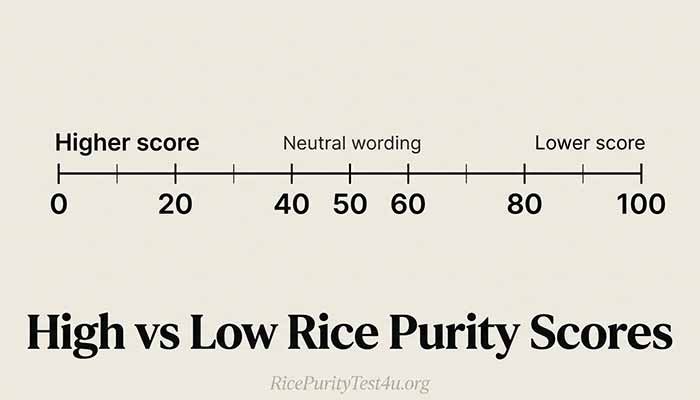
The easiest way to understand a result is to look at the difference between high and low scores.
What Does a High Rice Purity Score Mean?
A high Rice Purity score generally means you marked fewer items on the test as experiences you have had.
Someone with a score in the upper part of the scale may simply have had fewer experiences covered by the questions. Age, lifestyle, personal boundaries, relationships, social situations, and countless other factors can affect the result.
A high score does not prove that someone is more responsible, mature, innocent, or morally better than another person.
It is just a quiz score based on the answers given.
What Does a Low Rice Purity Score Mean?
A lower score generally means a person has checked off more experiences included in the quiz.
Again, the number does not provide a complete picture of that person.
Two people could have the same score while having checked completely different questions. That makes a simple Rice Purity score comparison much less meaningful than it might first appear.
For example, your friend might score 65 and you might score 65 too. That does not mean your life experiences are identical. It only means the scoring totals happened to end up in the same place.
That’s part of what makes comparing results interesting—and also why those comparisons should stay lighthearted.
Is 80 A Good Rice Purity Score?
Yes, an 80 can be a perfectly normal result in the context of the quiz.
But the better way to answer “Is 80 a good Rice Purity score?” is to remember that the test does not have an official good-versus-bad scale.
A score of 80 generally indicates that you checked a relatively limited number of the experiences included in the test.
For a college student taking the quiz with friends, seeing an 80 might spark curiosity about how everyone else answered. That can be fun. Just don’t turn it into a competition where the highest or lowest number somehow wins.
The score is only useful for entertainment and self-reflection.
If you got an 80, there is no need to wonder whether you “should” have scored higher or lower. Your result simply reflects the answers you gave.
Read More: What Is A Good Rice Purity Score?
Is 60 A Good Rice Purity Score?
A score of 60 is also just another possible Rice Purity Test result.
If you are asking “Is 60 a good Rice Purity score?”, the same principle applies: there is no official standard saying that 60 is good, bad, normal, or abnormal.
Compared with an 80, a 60 usually means more questions were checked off.
That’s all the number can reliably tell you.
It cannot explain the circumstances behind those experiences, when they happened, why they happened, or how you feel about them now.
This is one reason I think people sometimes give the final number more power than it deserves. A quiz can summarize checked boxes. It cannot summarize an entire person.
What About the Average Rice Purity Score?
People often search for an average Rice Purity score because they want to know whether they are similar to everyone else.
That curiosity makes sense. You finish a quiz, see a number, and immediately wonder, “Okay, but what does everyone else get?”
The problem is that you should be careful with averages you see online.
Different Rice Purity Test websites may attract different audiences, and informal online results are not necessarily based on a representative sample of the US population or US college students. Without reliable methodology and verified data, there is no single average that should be treated as the universal benchmark.
Age can matter too. A group of first-year college students and a group of older adults would not necessarily produce similar results because they have had different amounts of time and different opportunities for life experiences.
So rather than worrying about whether your score is above or below an online average, focus on what your own answers mean to you.
Does this sound familiar? Sometimes seeing a friend’s result makes your own score suddenly feel high or low. That reaction is understandable, but it doesn’t make either result better.
Why Rice Purity Score Comparison Can Be Misleading

Comparing Rice Purity scores is one of the biggest reasons people take the quiz together.
With the right group, that can be hilarious and surprisingly interesting.
Still, a Rice Purity score comparison has some obvious limits.
Suppose one friend gets 85, another gets 70, and another gets 55. You can see the numerical difference, but you cannot tell which exact questions created that difference unless everyone chooses to discuss their answers.
Even then, nobody owes the group an explanation.
Some questions touch on personal experiences that people may prefer to keep private. You can share your final score without sharing individual answers, or you can keep everything to yourself.
A good rule for playing with friends or a partner is simple: keep sharing optional.
That makes the quiz much more comfortable.
Why Your Age and Life Experience Can Affect Your Score
Rice Purity scores do not exist in a vacuum.
Someone who has had more years of adult life may have encountered more of the situations covered by the test. Someone younger may simply have had fewer opportunities to encounter them.
Relationships, social habits, college experiences, personal preferences, and individual boundaries can also influence the answers.
Because of that, comparing scores between people in very different stages of life does not tell you much.
Even comparisons between people the same age have limits. Everyone moves through life differently.
That’s normal.
The Rice Purity Test turns a set of yes-or-no answers into a number. It does not account for context, and context matters in real life.
Should You Try to Get a Certain Rice Purity Score?
No target score is necessary.
Trying to manipulate your answers to reach a particular result defeats most of the fun.
If you want the result to mean anything at all, answer based on your actual experiences. Then see what number you get.
You also do not need to change your real-life behavior because you want a different Rice Purity score later.
The quiz is supposed to reflect experiences—not direct them.
Whether you score 95, 80, 60, 40, or somewhere else on the scale, your number should stay in its proper place: a result from an entertainment quiz.
How to Use Your Rice Purity Score in a Healthy, Fun Way
The simplest approach is to stay curious without becoming judgmental.
If you take the test with friends, you might compare final scores and laugh at how different they are. Couples might use certain questions as conversation starters. Someone taking it alone might simply enjoy seeing how their answers have changed over time.
You can keep a few basic ideas in mind:
- Answer honestly if you want an accurate personal result.
- Never pressure someone to reveal individual answers.
- Avoid treating higher or lower scores as better.
- Remember that people with similar scores may have very different experiences.
- Keep the test in the entertainment category.
I think the quiz is at its best when the score starts a conversation rather than ends one.
A number can be interesting. It just shouldn’t become a label.
So, What Is A Good Rice Purity Score?
Ultimately, what is a good Rice Purity score depends on what you mean by “good.”
If you mean a score that accurately reflects your honest answers, then any result can work.
If you mean a number that proves someone is better, healthier, more mature, or more respectable than someone else, the Rice Purity Test cannot give you that answer.
An 80 is not automatically better than a 60. A 60 is not automatically more interesting than an 80. A high score and a low score simply represent different sets of responses to the quiz.
Take your result, have some fun with it, and keep it in perspective.
That’s really all a Rice Purity score needs to be.
FAQs:
CTA: Curious where your own answers will land? Keep it fun, answer honestly, and see your result for yourself.